Your customers are not only searching on Google anymore.
They are asking ChatGPT for recommendations. They are using Perplexity to compare products. They are asking Gemini what tools, services or brands they should trust. They are seeing answers from Google AI before they ever click a website.
That means your brand might be getting recommended before someone visits your site.
Or your competitors might be.
This guide shows you how to check whether your brand appears in AI search, how to see who is being mentioned instead, and what to improve if your brand is missing.
If your real question is “how do I check if my brand appears in ChatGPT?”, use this as a practical answer engine optimization workflow: test the prompts buyers use, record ChatGPT brand mentions and Perplexity brand mentions, then compare your visibility against competitors.
What is AI search visibility?
AI search visibility is simply this:
When someone asks an AI platform a question related to your product, service or category, does your brand appear in the answer?
For example, someone might ask:
What are the best project management tools for a small agency?
Or:
Which skincare brands are good for sensitive skin?
Or:
Best AI tools for tracking brand visibility?
The answer may include a few recommended brands. If your brand appears, you have a chance to win that customer.
If your competitor appears and you do not, they may get the attention before you are even considered.
That is why AI visibility matters. It is not just about website traffic. It is about whether your brand is part of the answer when customers are making decisions.
Why checking your own brand name is not enough
A lot of people start by typing their brand name into ChatGPT.
That is useful, but it does not show the full picture.
Most customers do not begin by searching for your brand. They usually start with a problem, a category or a comparison.
They ask things like:
- What is the best software for X?
- Which company should I use for Y?
- What are the top alternatives to Z?
- Which brands are best for this problem?
So the real question is not only:
What does AI say about my brand?
The better question is:
Does AI mention my brand when customers are searching for what we sell?
That is where the useful insight starts.
Step 1: Write down the questions your customers would ask
Start with 10 to 20 questions a real customer might ask before buying.
Do not make them too polished. Write them the way someone would actually search.
For example, if you sell accounting software, you might test:
- Best accounting software for freelancers
- What bookkeeping tool should a small business use?
- Xero alternatives for startups
- Best accounting software for UK businesses
If you run a design agency, you might test:
- Best UX design agencies in London
- How do I choose a product design agency?
- Top branding agencies for SaaS companies
- Best web design agency for startups
If you sell an ecommerce product, you might test:
- Best office chair for back pain
- Best skincare brand for dry skin
- What are the best running shoes for beginners?
The point is to think like the customer. They may not know your brand yet. They just know the problem they want solved.
Step 2: Search the same questions across each AI platform
Once you have your list of questions, test them across the main AI search platforms:
- ChatGPT
- Perplexity
- Gemini
- Google AI
Search the same question on each platform.
Do not assume they will all give the same answer. They often mention different brands, use different sources and describe companies in different ways.
For each search, look for four things:
- Was your brand mentioned?
- Which competitors were mentioned?
- Was your brand described accurately?
- Were any sources or websites cited?
You do not need a complicated system at the beginning. A simple spreadsheet is enough.
Use columns like:
| Question | Platform | Was your brand mentioned? | Competitors mentioned | Notes |
|---|---|---|---|---|
| Best tools for X | ChatGPT | Yes | Competitor A, Competitor B | Mentioned third |
| Best tools for X | Perplexity | No | Competitor A | Cited a review site |
| Best tools for X | Gemini | Yes | Competitor B | Description was outdated |
| Best tools for X | Google AI | No | Competitor A, Competitor C | Missing completely |
After 10 to 20 searches, you will usually start seeing patterns.
Maybe your brand appears when someone searches your name, but not when they search the category. Maybe one competitor keeps appearing everywhere. Maybe AI platforms understand what you do, but describe it badly.
Maybe your website is not giving them enough clear information to work with.
Those patterns tell you what to fix.
Step 3: Look at who appears instead of you
This is the part most brands should pay attention to.
If your brand is missing, who is being recommended instead?
Write down the competitors that appear most often.
Then ask:
Why might AI be choosing them?
Usually, it is because they have stronger signals online.
That might include:
- Clearer website copy
- More useful blog content
- Comparison pages
- Review site listings
- Mentions from trusted websites
- Better product pages
- More consistent positioning
- More recent content
For example, if a competitor is being recommended as “best for small teams”, they may have content that clearly connects them with that use case.
If another competitor keeps showing up in Perplexity, check the sources being cited. Perplexity may be pulling from review sites, listicles, product directories or articles where that competitor is mentioned.
This gives you a roadmap.
You are not just checking whether you appear. You are learning what AI platforms currently trust in your market.
Step 4: Check whether your brand is described properly
Showing up is good.
Showing up with the wrong description is not.
Sometimes AI platforms mention a brand but get important details wrong. They might describe an old product, outdated pricing, the wrong audience, missing features or a vague version of what the company actually does.
When your brand appears, ask:
- Does this sound like us?
- Is the product description accurate?
- Does it mention the right audience?
- Does it explain the main benefit clearly?
- Would this answer make someone want to visit our website?
- Is anything outdated or misleading?
If the answer is weak or wrong, that usually means your public information needs to be clearer.
Your homepage, product pages, FAQs, comparison pages, blog posts, LinkedIn page, directory profiles and third-party mentions all help AI platforms understand your brand.
The clearer and more consistent those signals are, the better chance you have of being described correctly.
Step 5: Work out why your brand is missing
If your brand does not appear, it usually comes down to one of these problems.
Your website is too vague
A lot of websites sound professional but do not clearly say what the product does.
For example:
We help teams unlock growth with smarter workflows.
That sounds nice, but it is vague.
A clearer version would be:
We help SaaS teams track how often their brand appears across ChatGPT, Perplexity, Gemini and Google AI.
AI platforms need clear language. They need to understand what you do, who you help and when your brand should be recommended.
You do not have enough content around customer questions
If customers are asking “best tools for X”, “how to solve Y” or “alternatives to Z”, your site should have content that answers those questions.
A homepage alone is usually not enough.
You may need pages like:
- Best tools for your category
- How to choose a product like yours
- Your brand vs competitors
- Alternatives to a popular competitor
- Use-case pages for specific customer types
- Guides that explain the problem you solve
This gives AI platforms more context about where your brand fits.
Your competitors have more third-party mentions
AI platforms do not only look at your website.
They may also use review sites, directories, articles, forums, newsletters, documentation, social posts and other pages across the web.
If your competitors are mentioned in more trusted places, they may be easier for AI platforms to recommend.
That does not mean you need to be everywhere. But you do need enough credible mentions for AI systems to understand that your brand belongs in the conversation.
Your positioning is inconsistent
If your website says one thing, your social profiles say another, and third-party listings describe you differently, AI platforms may struggle to understand you.
Try to keep your core message consistent.
What do you do? Who is it for? What problem do you solve? What category are you in?
The clearer this is across the web, the easier it is for AI platforms to connect your brand with the right searches.
Step 6: Improve your chances of appearing
Once you know where you are missing, start with the basics.
Make your homepage more specific
Your homepage should quickly explain:
- What your product does
- Who it is for
- What platforms or channels it covers
- What problem it solves
- Why someone should care
Avoid vague language. Be direct.
A clear sentence is better than a clever one.
Create content around buying intent
Write about the questions people ask before they buy.
For example:
- How to check if your brand appears in AI search
- How to track brand mentions in ChatGPT
- How to improve your visibility in Perplexity
- Why competitors appear in AI search and you do not
- Best tools for tracking AI visibility
This type of content is useful because it matches real customer intent.
Add comparison pages
Comparison pages help both customers and AI platforms understand where you fit.
Good comparison content should be fair, not fake.
Explain who your product is best for, where competitors are strong, where your product is different, and which type of customer should choose each option.
This builds trust and makes your positioning easier to understand.
Get mentioned outside your own website
Look for places where your brand should naturally appear.
This could include:
- Product directories
- Review sites
- Industry blogs
- Partner pages
- Podcasts
- Newsletters
- Founder interviews
- Community discussions
Third-party mentions help show that your brand is real, relevant and trusted.
Keep old information updated
AI platforms can pick up outdated information.
Make sure your website, social profiles, listings and public descriptions are current.
If your product, pricing, features or audience has changed, update it everywhere you can.
Step 7: Check regularly, not just once
AI search changes.
Your competitors publish new content. Google results change. New articles get cited. AI platforms update their answers. Your own website changes too.
That means one check is only a snapshot.
To get a better view, check your AI visibility regularly.
At minimum, review it once a month.
If AI search is important to your growth, check it weekly.
Track:
- How often your brand appears
- Which platforms mention you
- Which prompts trigger your brand
- Which competitors appear most often
- Whether your description is accurate
- What sources are being used
- What changed after you improved your content
Over time, this becomes a useful feedback loop.
You check where you appear, improve the weak spots, then track whether your visibility gets better.
Quick checklist
Here is the simple version:
- Write down questions your customers would ask.
- Test them in ChatGPT, Perplexity, Gemini and Google AI.
- Record whether your brand appears.
- Note which competitors appear instead.
- Check whether your brand is described accurately.
- Look at the sources being used.
- Improve your website, content and third-party mentions.
- Repeat the check regularly.
The aim is not just to rank higher.
The aim is to become one of the brands AI platforms trust enough to mention when customers are ready to make a decision.
Track your AI visibility with Prescy
You can check AI visibility manually with a spreadsheet, but it quickly becomes difficult to manage.
An AI visibility tracker makes this easier by turning repeated checks into a clear view of where your brand appears, where competitors win, and which prompts need attention.
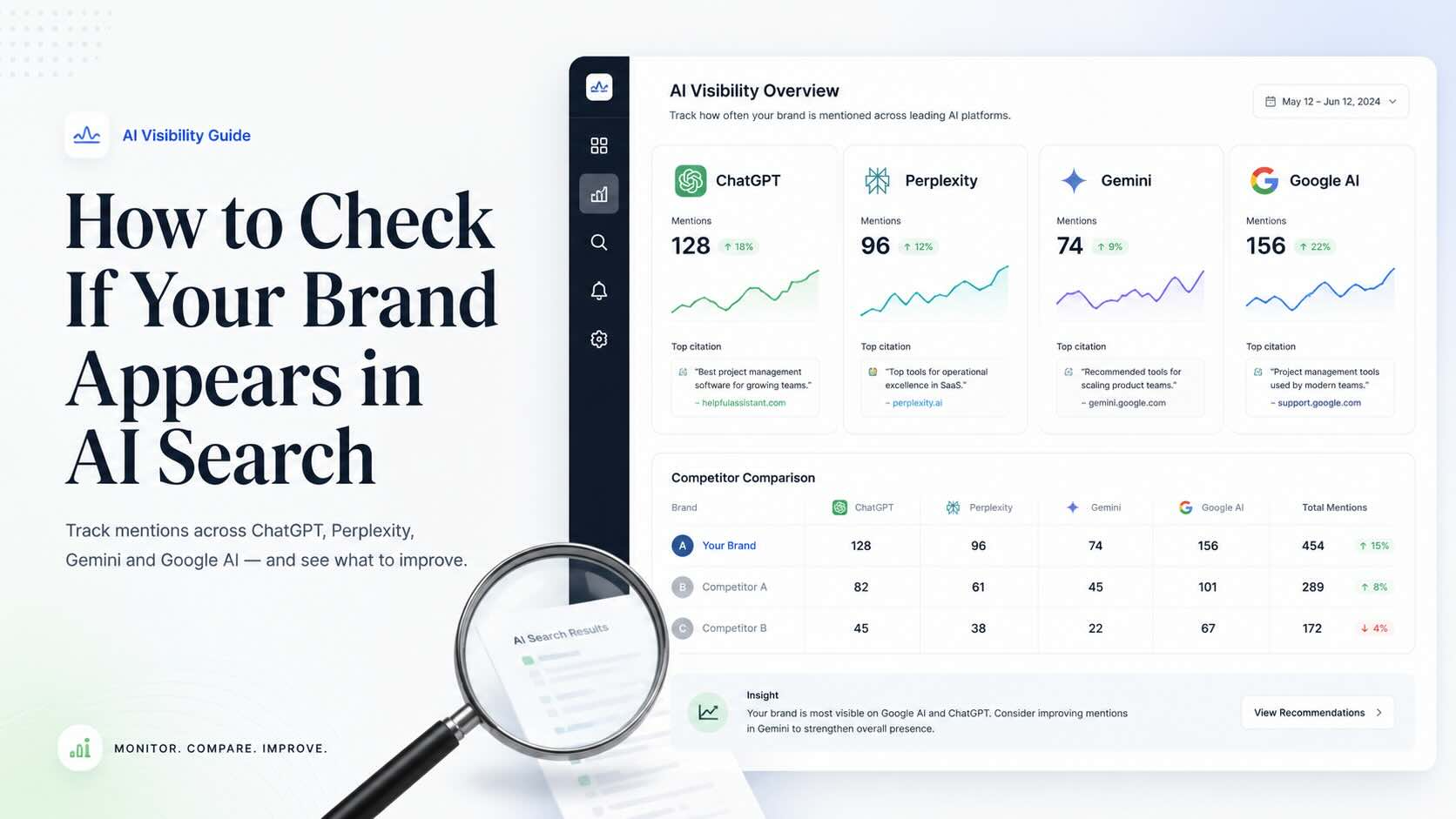
Prescy helps you track how often your brand is mentioned across ChatGPT, Perplexity, Gemini and Google AI.
You can compare your visibility against competitors, see where your brand is missing, and understand what to improve next.
So instead of guessing whether AI platforms are recommending you, you can monitor it clearly and take action.
Your customers may already be asking AI who to trust.
Prescy helps you see whether your brand is part of the answer.
Waitlist
Want to track this automatically?
Prescy helps you monitor how often your brand appears across ChatGPT, Perplexity, Gemini and Google AI, compare competitors and see what to improve.
Something went wrong. Please try again.