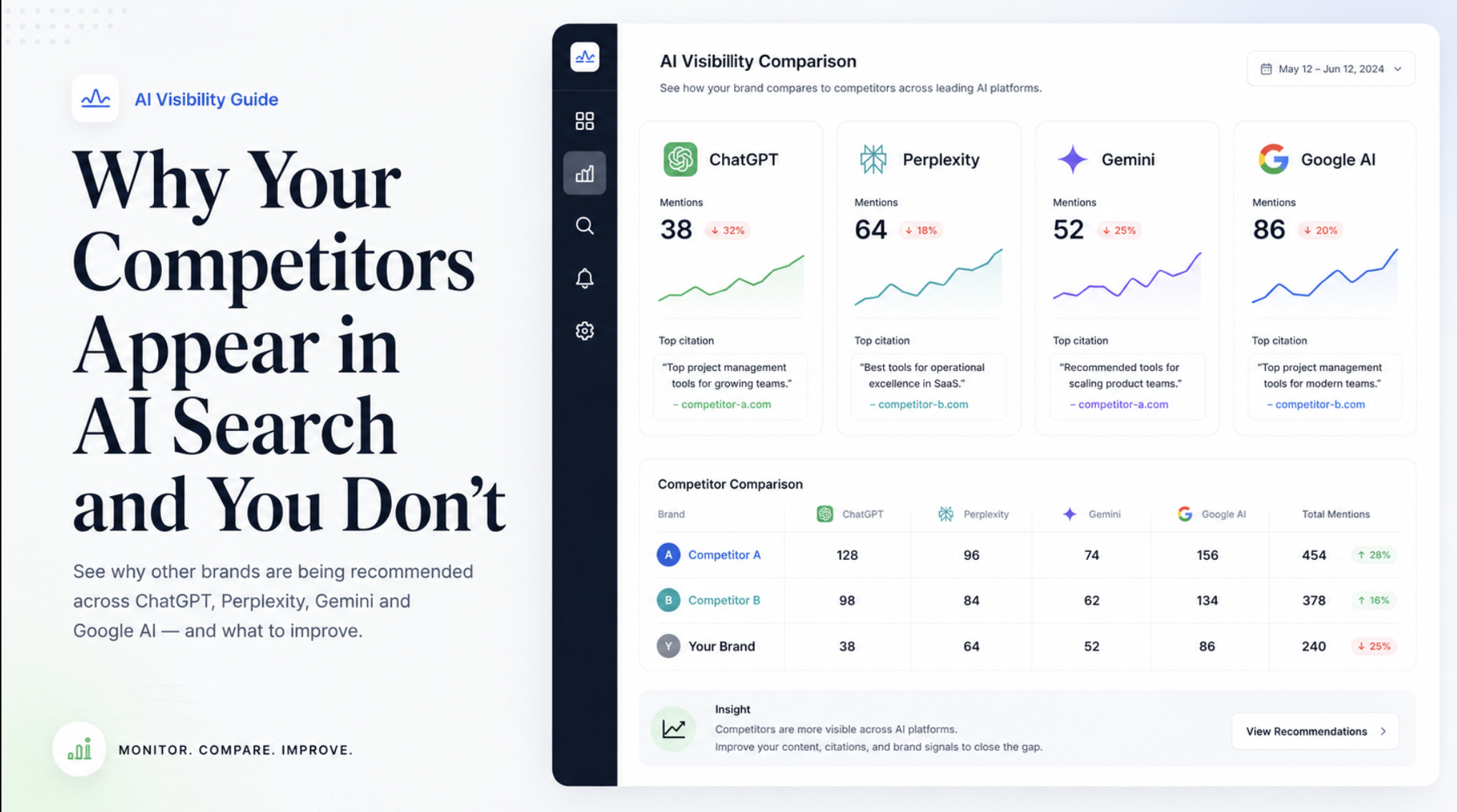
Your competitors may be showing up in ChatGPT, Perplexity, Gemini and Google AI before your brand is even considered.
That does not always mean they have a better product.
It often means AI platforms have clearer signals about who they are, what they do, who they help and why they should be recommended.
This is one of the biggest shifts in search.
Customers are no longer only scrolling through links. They are asking AI platforms questions like:
- What are the best tools for this?
- Which brand should I choose?
- What are the top alternatives?
- Who is best for this specific problem?
If your competitors appear in those answers and you do not, they get the first chance to win the customer.
This guide explains why that happens, how to spot the gaps, and what to improve so your brand has a better chance of appearing in AI search.
The uncomfortable truth
AI platforms do not recommend brands randomly.
They rely on signals.
Those signals can come from your website, product pages, blog content, review sites, comparison articles, directories, customer discussions, social profiles, press mentions and other pages across the web.
If your competitors appear more often than you, it usually means AI platforms have more useful or more trusted information about them.
That does not mean the situation is permanent.
It means there is a visibility gap.
Once you know what the gap is, you can start fixing it.
Reason 1: Their positioning is clearer
AI platforms need to understand what a brand does before they can confidently recommend it.
If your website is vague, your brand becomes harder to place.
For example, a homepage that says:
We help teams unlock growth through smarter workflows.
may sound professional, but it does not clearly explain what the product is.
A clearer version would be:
We help SaaS teams track how often their brand is mentioned across ChatGPT, Perplexity, Gemini and Google AI.
That sentence is easier to understand because it explains:
- who the product is for
- what the product does
- which platforms it covers
- what problem it solves
Your competitors may be appearing because their positioning is more specific.
They might clearly say they are “best for ecommerce brands”, “built for agencies”, “made for startups”, or “designed for enterprise teams”.
That gives AI platforms a stronger reason to mention them for those types of searches.
If your brand is missing, review your homepage and product pages.
Ask:
- Is it obvious what we do?
- Is it obvious who we help?
- Is it obvious what category we belong in?
- Is it obvious when someone should choose us?
- Could someone understand the product in five seconds?
If the answer is no, AI platforms may struggle too.
Reason 2: They answer customer questions better
AI search is often based on questions.
People ask things like:
- What is the best tool for X?
- How do I solve Y?
- What are the best alternatives to Z?
- Which product should I use for this situation?
If your competitors have content that answers those questions clearly, they have a better chance of appearing.
This does not mean publishing random blog posts.
It means creating content around real buying intent.
For example:
- best tools for your category
- how to choose a product like yours
- alternatives to a known competitor
- your brand vs another brand
- guides for specific use cases
- common problems your customers are trying to solve
A homepage alone is usually not enough.
If AI platforms are trying to answer a specific customer question, they need specific information.
Your competitors may be winning because they have more pages that explain where they fit, who they are best for, and why a customer should consider them.
Reason 3: They are mentioned on more trusted websites
Your own website matters, but AI platforms do not only rely on what you say about yourself.
They also look at what the wider web says about you.
That can include:
- review sites
- software directories
- ecommerce directories
- comparison articles
- industry blogs
- newsletters
- podcasts
- partner pages
- news articles
- community discussions
- forum threads
If your competitors are mentioned across more trusted sources, AI platforms may have more confidence in recommending them.
This is why third-party mentions are important.
They help confirm that your brand is real, relevant and part of the category.
If your competitor appears in articles like:
- Best tools for agencies
- Top ecommerce analytics platforms
- Best software for small businesses
and your brand does not, AI platforms may be more likely to include them.
You do not need to be mentioned everywhere.
But you do need enough credible mentions in the places your customers and AI platforms are likely to trust.
Reason 4: They have comparison and alternative pages
Comparison content is useful because it helps customers make decisions.
It also helps AI platforms understand how brands relate to each other.
If people are asking:
- Brand A vs Brand B
- Best alternatives to Brand X
- Which tool is better for small teams?
then comparison pages can give AI platforms useful context.
Your competitors may be easier to recommend because they have pages explaining:
- who their product is best for
- which alternatives exist
- how they compare to other tools
- what makes them different
- which customer types they serve
Good comparison content should be fair and useful.
It should not just say “we are better”.
It should explain the real differences between options.
For example:
- one tool may be better for solo founders
- another may be better for agencies
- another may be better for enterprise teams
- another may be cheaper but less advanced
This kind of content builds trust.
It also gives AI platforms clearer language to work with when answering comparison-based searches.
Reason 5: Their content is easier to understand and cite
AI platforms favour information that is easy to extract, understand and summarise.
If your content is buried in vague marketing language, it may not be as useful.
Good AI-friendly content is usually:
- clear
- specific
- structured
- up to date
- easy to scan
- written around real questions
- supported by examples
- consistent with the rest of your website
This does not mean writing for robots.
It means writing clearly for humans.
For example, instead of saying:
Our platform empowers modern teams with next-generation intelligence.
say:
Our platform tracks how often your brand is mentioned in AI search results, compares you against competitors, and shows what to improve.
That is easier for people to understand.
It is also easier for AI platforms to understand.
If competitors are being cited more often, look at their content structure.
Do they have clearer headings?
Do they answer the question faster?
Do they explain the category better?
Do they include useful examples?
Do they have pages that directly match what customers are asking?
Those details matter.
Reason 6: Your brand information is inconsistent
AI platforms build an understanding of your brand from many different sources.
If those sources describe you differently, your positioning becomes weaker.
For example, your homepage might say you help “marketing teams”.
Your LinkedIn page might say you help “founders”.
A directory listing might describe you as an “SEO tool”.
An old article might call you a “social listening platform”.
That kind of inconsistency can make it harder for AI platforms to understand when to mention you.
Try to keep your core message consistent across:
- your homepage
- product pages
- blog content
- directories
- review sites
- launch pages
- partner pages
- press mentions
You do not need every sentence to be identical.
But the core message should be clear.
What do you do?
Who do you help?
What problem do you solve?
What category are you in?
If that is consistent across the web, your brand becomes easier to understand and recommend.
Reason 7: Your content may be outdated
Sometimes your brand is missing because the information online is old.
AI platforms may find outdated pricing, old product names, old positioning, old feature lists or old descriptions.
This can happen if:
- your product has changed
- your website has been redesigned
- old blog posts are still ranking
- directory listings have not been updated
- review sites show old information
- public profiles use outdated copy
Outdated information weakens trust.
It can also make AI platforms describe you incorrectly or leave you out entirely.
Review the most important public pages about your brand.
Start with:
- your homepage
- pricing page
- product pages
- about page
- help docs
- LinkedIn page
- review profiles
- directory listings
- old launch pages
Make sure they describe the current version of your brand.
How to find the exact gap
The best way to understand why competitors appear is to compare prompts across AI platforms.
Choose 10 to 20 questions your customers might ask.
For example:
- Best tools for tracking AI search visibility
- How do I monitor brand mentions in ChatGPT?
- What are the best tools for comparing brand visibility in AI search?
- Which platforms help brands get found in AI search?
Then test those questions in:
- ChatGPT
- Perplexity
- Gemini
- Google AI
For each result, record:
- whether your brand appeared
- which competitors appeared
- how each competitor was described
- whether sources were cited
- which sources were used
- whether the answer was accurate
- what type of content seemed to influence the answer
A simple spreadsheet is enough at first.
Use columns like:
| Question | Platform | Your brand mentioned? | Competitors mentioned | Sources cited | What this tells us |
|---|---|---|---|---|---|
| Best tools for X | ChatGPT | No | Competitor A, Competitor B | None shown | Competitors are better known in this category |
| Best tools for X | Perplexity | No | Competitor A | Review site | Need third-party mentions |
| Alternatives to X | Gemini | Yes | Competitor C | Blog post | Brand appears for comparison queries |
| Best product for Y | Google AI | No | Competitor B | Directory | Missing from trusted category pages |
After a few searches, patterns will appear.
You might find that:
- one competitor appears across every platform
- your brand only appears when searched by name
- Perplexity relies heavily on third-party articles
- Gemini describes your product incorrectly
- Google AI pulls from directory-style pages
- your competitors have stronger comparison content
Those patterns show you what to fix first.
What to fix first
If your brand is missing from AI search, start with the areas most likely to make a difference.
1. Make your homepage clearer
Your homepage should explain your product in plain language.
A visitor should understand what you do in a few seconds.
Avoid vague claims. Be direct.
Say what you do, who it is for and why it matters.
2. Create content around customer intent
Write pages that match what customers are already asking.
Useful topics include:
- how to solve a specific problem
- best tools for a specific use case
- comparison pages
- alternative pages
- category guides
- beginner guides
- buyer checklists
This helps both people and AI platforms understand where your brand fits.
3. Improve your product and use-case pages
If you serve different audiences, create pages for them.
For example:
- for SaaS companies
- for ecommerce brands
- for agencies
- for marketing teams
- for founders
Specific pages are easier to match to specific AI searches.
4. Build third-party mentions
Look for trusted places where your brand should be included.
This might be product directories, review sites, guest posts, partner pages, newsletters or industry blogs.
The goal is not just backlinks.
The goal is to make your brand visible in the places AI platforms may use as evidence.
5. Keep your brand message consistent
Use similar language across your website and public profiles.
Make sure your category, audience and main benefit are clear everywhere.
Consistency helps AI platforms understand your brand with more confidence.
The main thing to remember
Your competitors may not be appearing because they are better.
They may be appearing because they are easier for AI platforms to understand, trust and recommend.
That is good news.
Because it means you can improve your visibility.
You can make your positioning clearer.
You can answer better customer questions.
You can create stronger comparison content.
You can earn more third-party mentions.
You can update old information.
And you can track whether those changes are helping.
AI search visibility is not magic.
It is a new kind of search presence that can be monitored and improved over time.
Track competitor visibility with Prescy
Checking this manually is possible, but it quickly becomes hard to manage.
Prescy helps you track how often your brand and competitors appear across ChatGPT, Perplexity, Gemini and Google AI.
You can see where your brand is showing up, where competitors are beating you, and what to improve next.
Your customers may already be asking AI platforms who to trust.
Prescy helps you see whether your brand is part of the answer.
Waitlist
Want to see which competitors are beating you in AI search?
Prescy helps you track how often your brand and competitors appear across ChatGPT, Perplexity, Gemini and Google AI, so you can see where you’re missing and what to improve next.
Something went wrong. Please try again.