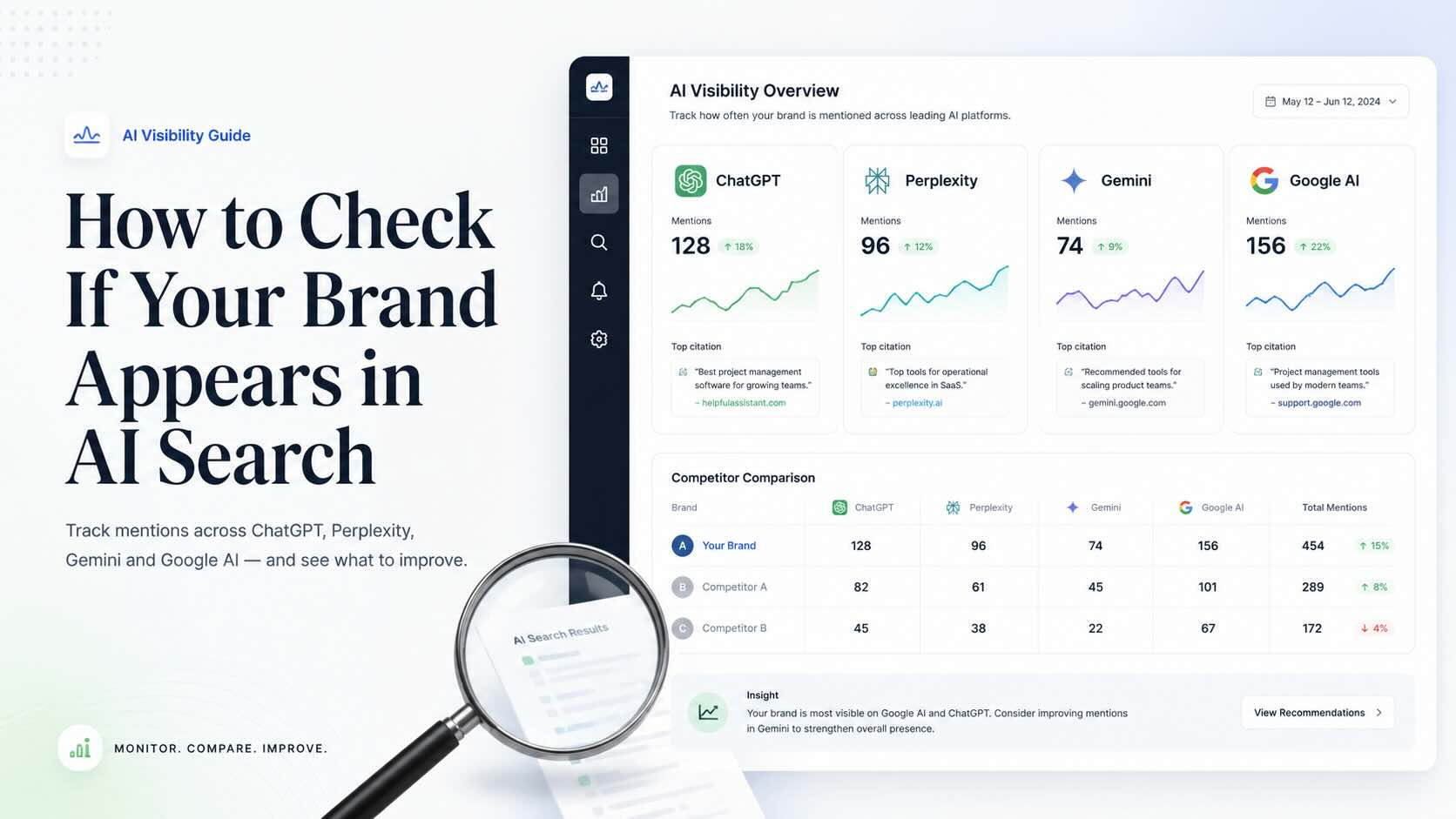
More and more buying decisions now start with a question typed into an AI assistant rather than a search box. Someone asks ChatGPT for the best tool for their team, asks Perplexity to compare two products, or reads a Google AI Overview before clicking a single link. In each of those moments an AI system decides which businesses to name — and which to leave out.
AI visibility tracking is how you find out whether your business is the one being named.
This guide explains what AI visibility tracking is, why it matters, how it differs from SEO and reputation management, and how the tracking actually works.
What is AI visibility tracking?
AI visibility tracking is the practice of measuring how often, and how well, an AI system mentions your business when people ask it questions related to what you sell.
Instead of checking where you rank on a page of blue links, it checks something different: when a customer asks an AI assistant for a recommendation, does the answer include you?
A complete approach tracks this across the AI systems people actually use to make decisions:
- ChatGPT
- Claude
- Gemini
- Perplexity
- Google AI Overviews
Each of these answers from its own model and its own sources, so being well known to one says very little about the others. Tracking means asking each system the same real customer questions, then recording whether your business appears in the answer — and who appears instead.
Why AI visibility matters for businesses
For years, being found meant ranking on Google. That still matters, but a growing share of customers never reach the list of links. They ask an AI assistant, read the answer, and act on the two or three businesses it names.
That changes the stakes in a specific way. On a search results page, being tenth still puts you on the page. In an AI answer, there is no tenth place. The assistant usually names a small handful of businesses, and everyone else is simply absent. If a competitor is in that handful and you are not, they are considered before you ever enter the conversation.
This is why AI visibility is worth measuring rather than guessing at. You cannot improve — or even notice — a problem you have never seen. And because these answers happen inside private conversations, not on a public page you can refresh, the only way to know where you stand is to test the questions your buyers ask and read what the AI actually says.
How AI visibility tracking is different from SEO and reputation management
AI visibility tracking overlaps with a few things you may already do, but it answers a different question from each of them.
| Approach | The question it answers | Where it looks |
|---|---|---|
| AI visibility tracking | Does AI recommend my business when buyers ask? | Answers from ChatGPT, Claude, Gemini, Perplexity and Google AI Overviews |
| Traditional SEO | Where do I rank in the list of links? | Search engine results pages |
| Online reputation management | What do people say about me? | Reviews, ratings and press |
| Social listening | Where and how am I mentioned by people? | Social posts and public conversations |
It is not the same as SEO
SEO measures your position in a ranked list of web pages. AI visibility measures whether you appear inside a written answer that names only a few businesses. Good SEO can help — AI systems often draw on the same web content — but a strong ranking does not guarantee a mention, and some businesses that rank modestly still get named because their information is clear and easy to cite.
It is not the same as reputation management
Online reputation management is about sentiment: the reviews, ratings and press that shape what people think of you. AI visibility is about presence: whether an AI names you at all when someone asks for options. You can have excellent reviews and still be invisible in AI answers, because the assistant never surfaced you in the first place.
It is not the same as social listening
Social listening tracks what humans post about your brand across social platforms. AI visibility tracks what machines say about your brand when asked for a recommendation. One watches public conversation; the other watches the private answers that increasingly decide who makes a buyer's shortlist.
How AI visibility tracking actually works
Good tracking is a repeatable measurement loop, not a one-off search. It works in a few steps.
1. Start with the questions buyers actually ask
The most useful searches are not your brand name. They are the problems, categories and comparisons customers use before they have chosen anyone:
Best project management tool for a small agency
Which CRM should a startup use?
These reveal whether AI recommends you when your name was never mentioned — the moment that decides most new customers.
2. Ask each AI system the same questions
Because every assistant answers differently, each question is asked across all of them. This is what turns a vague impression into a per-engine picture: strong on one platform, missing on another.
3. Check each answer for your business — and your competitors
Every answer is read for whether your business appears, including aliases and your domain, and for which competitors appear alongside or instead of you. Seeing who gets named in your place is often more useful than your own result.
4. Keep the evidence
The value is in the verbatim answers and the sources cited, not a paraphrase. Keeping the original text lets you audit every result and understand why an answer looked the way it did.
5. Act, then measure the change
Tracking earns its keep when it closes the loop. You make a change, then run the same questions again and compare like-for-like: did visibility improve, stay unclear, or decline? One result is an early signal; two consistent results are stronger evidence. This is the difference between hoping a fix worked and knowing.
What an AI visibility score tells you
Tracking a dozen questions across five systems produces a lot of individual results. A visibility score condenses them into one comparable number so you can see your position at a glance and watch it move over time.
Prescy's score runs from 0 to 100 and combines two things: breadth (how many of the five systems mention you at all) and depth (your share of answers within each system). Because the same score is calculated identically for competitors, you can compare yourself against them fairly. You can read the full approach on the methodology page.
Who should track AI visibility?
AI visibility tracking is most valuable for any business where customers research before they buy — which is most of them. In practice it matters most to:
- Founders and marketers who want to know whether AI recommends them for the searches that bring in customers.
- Agencies managing visibility for several clients and needing to show what changed.
- SEO and content teams extending their work from search rankings to AI answers.
If your competitors are being recommended in AI answers and you are not, the gap compounds quietly — which is exactly the case for measuring it. We cover that dynamic in more depth in why your competitors appear in AI search and you don't.
How to start tracking your AI visibility
You can do a basic version by hand: write down ten questions your customers might ask, put each one into ChatGPT, Claude, Gemini and Perplexity, and note whether you appear and who appears instead. Our guide on how to check if your brand appears in AI search walks through that manual workflow.
The manual approach is a good way to see the problem. It becomes hard to sustain once you want to repeat the same questions every week, across every engine, and measure whether your changes actually moved anything — which is the point where automated tracking pays off.
The fastest way to see where you stand is to run a free AI visibility check: enter your website, and you will see how the major AI systems answer a real customer question about a business like yours — no signup required. If you have more questions first, the FAQ answers the common ones.